MbDFEM Simulation of a Tree Wrench.
Problem Description.
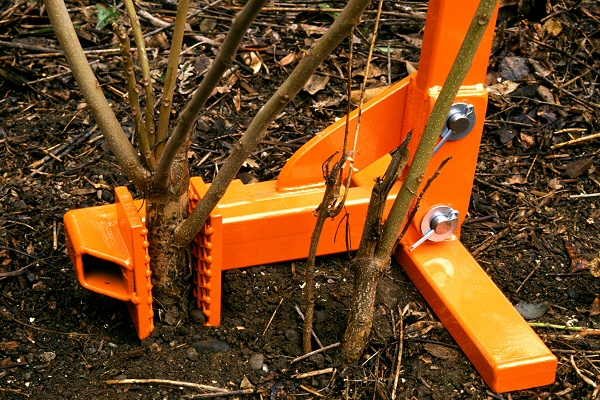
Here we present a first real-world application of the MbDFEM software: the study of the stresses developed in the components of a “tree wrench” (or “tree puller”) assembly. A tree wrench is a gardening tool used to extract small trees or bushes from the ground. It is a human-powered tool that relies on the mechanical advantage of a long lever to facilitate the extraction of all or most of the plant's roots.
The image on the right shows the bottom-side assembly of such a tool. The wrench is composed of a slider joint that constrains the motion of two “jaws.” These jaws trap the main stem of the plant and, as the lever (handle) is pulled by the operator, they draw the plant out of the ground.
The video on the left shows the operation of the assembly. The motion of the handle is imposed by a time-dependent sine function that sets the distance between the top of the handle (the cylindrical face) and a grounded “dummy” part. The compression force, applied by the inner and outer jaws to the plant stem, is modeled as a high-stiffness spring connecting these two jaws. The lifting force that extracts the tree is modeled using two lower-stiffness springs that connect each jaw to the ground.
It is assumed that the maximum pulling force a person can apply to the handle is 900 N. To achieve this pulling force, the stiffness of the three springs was adjusted while measuring the force applied to the handle by the imposed-motion joint, until the desired 900 N pulling force was reached at maximum spring elongation.
The video on the right offers a close-up perspective of the bottom side of the assembly. The horizontal spring represents the tree stem, and it gets compressed as the two jaws get closer due to the pulling force. The two vertical springs model the lifting force, which pulls the tree out.