To prevent rigid-body motion, three nodes of the pendulum FEM mesh are selected and a “321” constraint is applied. This constraint fully restrains the first node in all its three displacement degrees of freedom (X, Y and Z), the second node in its two displacement degrees of freedom (Y and Z), and the third node in a single displacement degree of freedom (Z). For each time step, the reaction forces at these constrained nodes are recorded. A key mechanism for validating the simulation consists in comparing the hinge joint forces and the corresponding distributed FEM loads, with the reaction forces at the nodes subjected to the 321 constraint. Under ideal application of d'Alembert's principle, the pendulum would remain in perfect static equilibrium throughout all its motion, and the 321 reaction forces would become zero. In practice, numerical approximations introduce minor errors, resulting in the 321 forces being a negligible fraction of the applied FEM loads.
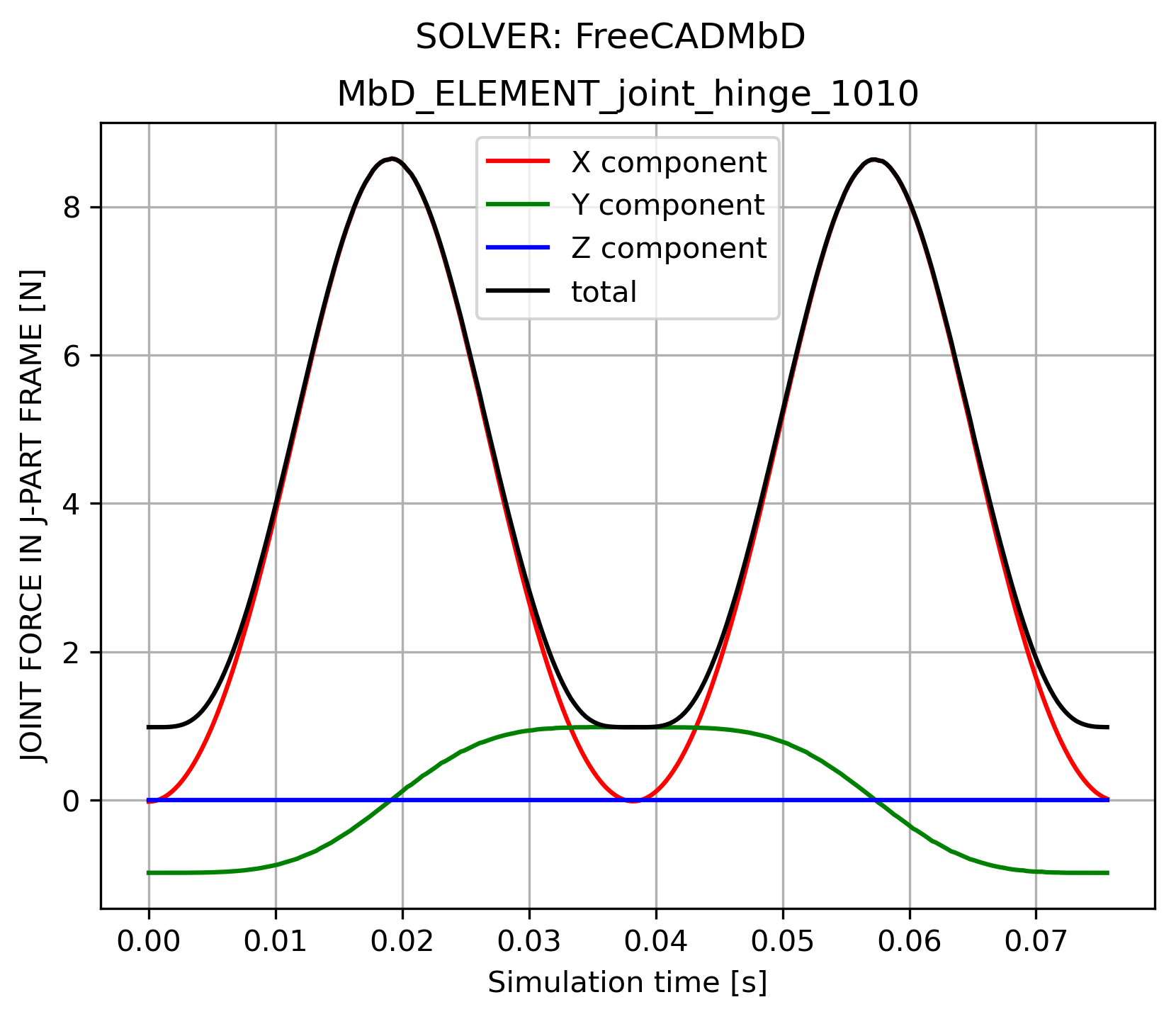
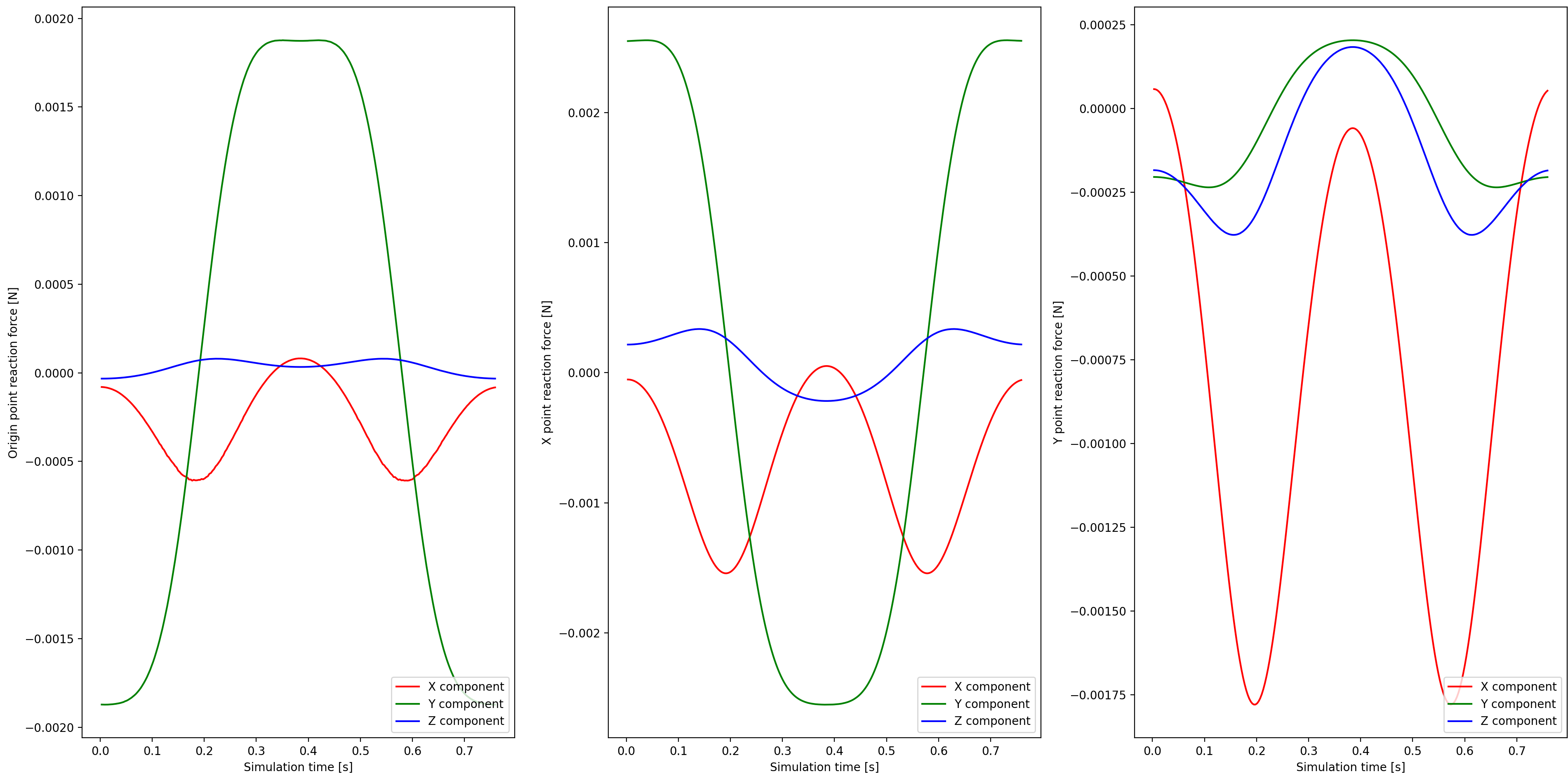
The images below illustrate the hinge joint force expressed in the frame of the pendulum (left), and the pendulum 321 reaction forces also expressed in its own frame (right). It can be observed that the 321 forces remain approximately three orders of magnitude smaller than the joint forces, throughout all the simulation time. This leads tor the conclusion that the pendulum is indeed in static equilibrium across its dynamic motion (quasi-static), and that the d'Alembert principle is correctly applied.
A secondary approach for verifying the simulation involves examining the stresses at the nodes subjected to the 321 constraint. If the reaction forces at these constrained nodes were a significant fraction of the applied loads, the FEM solver would predict correspondingly high stresses concentrated at these points. However, the stresses at the 321-constraint nodes are negligible in comparison to the stresses resulting from the hinge joint FEM loads. This observation can be confirmed from the stress videos presented before, where no stress can be appreciated at the nodes where the 321 constraint is applied.